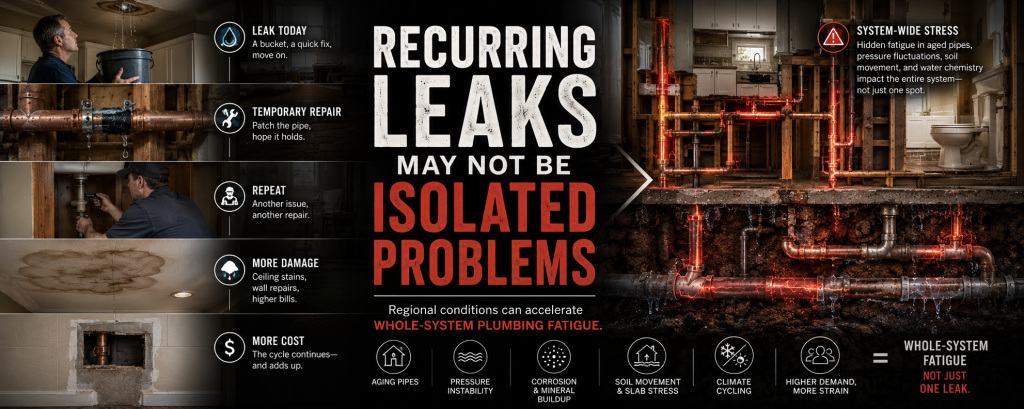
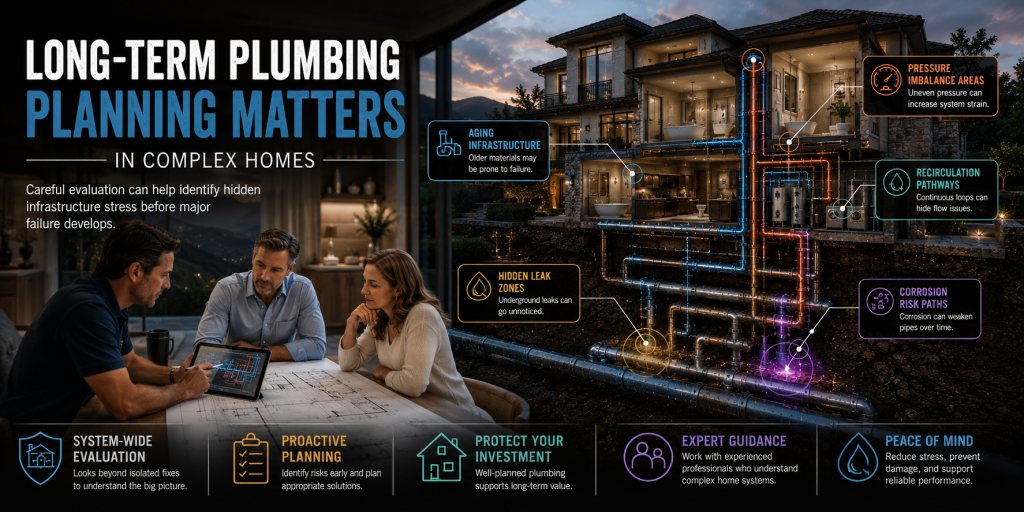
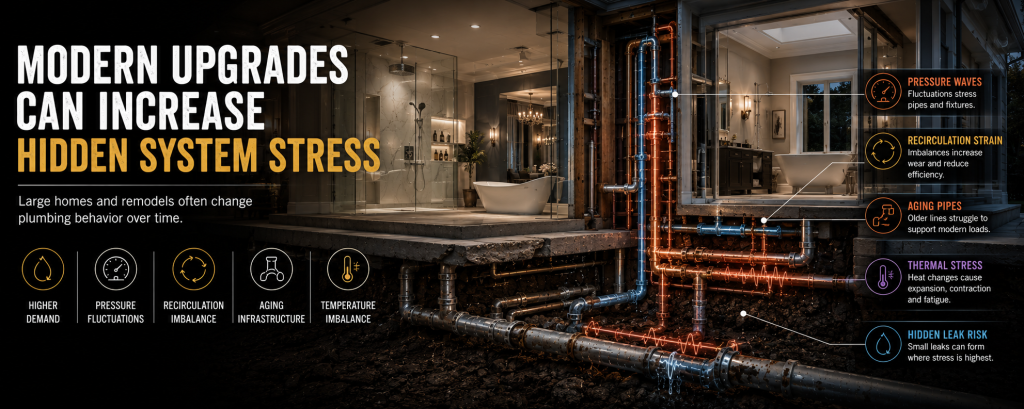
These are not isolated events. They are system signals.
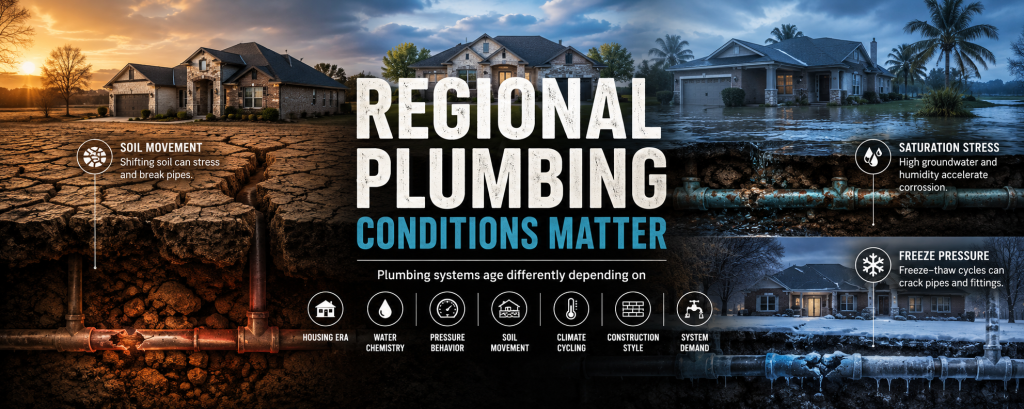
Plumbing systems do not fail randomly. They follow patterns — shaped by material, pressure, environment, and time.
In high-value repipe markets like San Jose, Fremont, and Palo Alto, small failures carry larger consequences. Water damage is no longer just a repair. It is a property risk.
What This Page Does
A structured way to read system behavior
Most homeowners respond to visible damage. This page explains what creates that damage — the patterns, pressures, and material conditions that operate silently until failure becomes unavoidable.
This page covers:
01
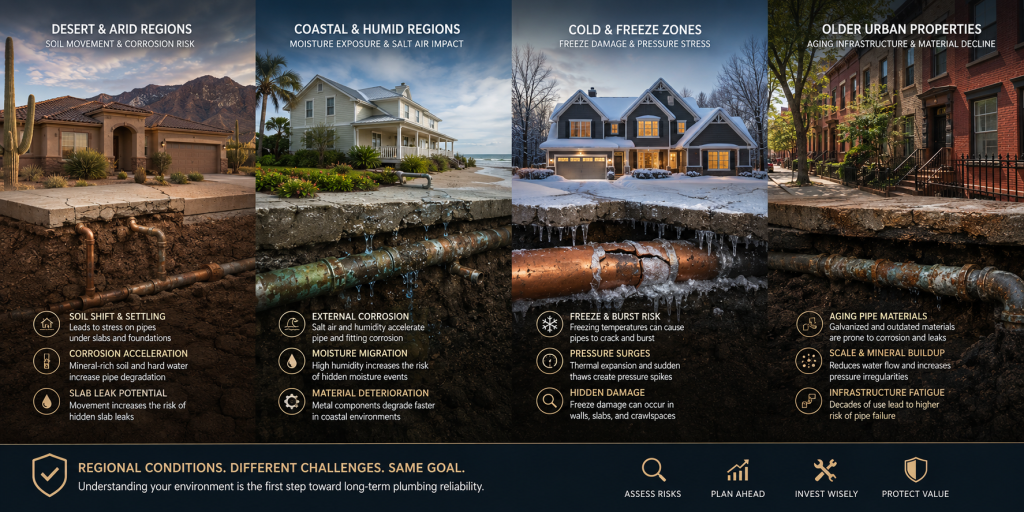
How regional environments shape plumbing failure patterns
02
What pressure instability and material degradation actually look like
03
When repair becomes a temporary response to a permanent condition
04
What a structured repipe decision framework looks like in practice
05
Why regional context changes every evaluation
The goal is not to create anxiety. It is to replace guesswork with a framework that makes existing information legible.
Every home has a system story.
This page provides the framework to read it correctly.
Pressure & Flow
Pressure, Flow, and Hidden System Stress
Pressure does not stay constant. It shifts as systems age, changes when sections are replaced, and reacts to demand. Homes in Fremont and Santa Clara often show stable resting pressure — then drop or spike under simultaneous use.
Mineral content shifts between Livermore, Stockton, and Granite Bay. Older infrastructure in Oakland and Berkeley behaves differently from newer builds in El Dorado Hills. These differences shape how systems fail over time.
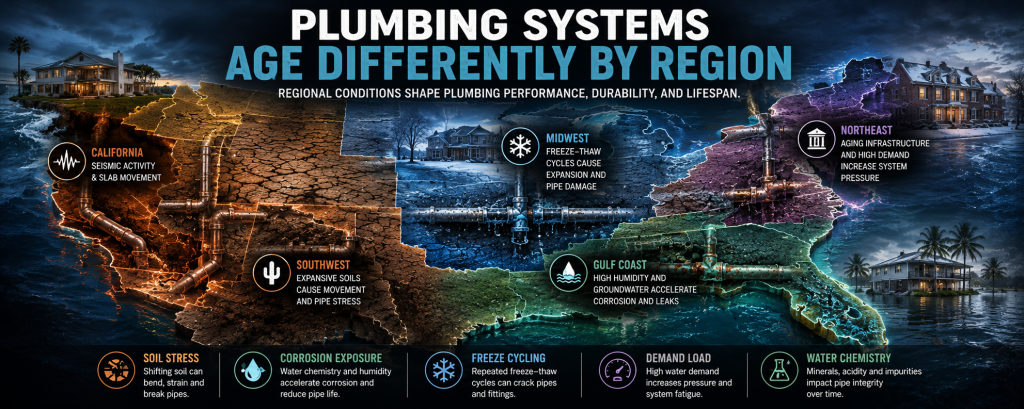
Similar patterns appear nationally. Phoenix and Las Vegas show mineral-driven scaling. Chicago and Boston show aging infrastructure collapse. Denver combines pressure variability with temperature stress. The mechanics stay consistent. The timing changes.
These patterns define when repair stops working — and when a full system replacement becomes necessary.
Pressure imbalance under load
Internal corrosion from water chemistry
Material incompatibility across upgrades
Flow restriction from aging lines
Structural stress from poor support
Bay Area — Coastal vs. Inland
San Mateo and San Francisco face salt-air corrosion pressure. Concord and Antioch operate on harder inland water with mineral-driven scaling inside pipes.
Phoenix & Las Vegas — Mineral Scaling
High mineral content creates scaling buildup inside lines. Flow becomes restricted. Pressure increases behind those restrictions. The cycle accelerates failure.
Chicago & Boston — Infrastructure Age
Aging galvanized systems collapse internally. Repeated freeze-thaw cycles fatigue copper. Systems appear stable until seasonal stress reveals underlying weakness.
Denver — Pressure & Temperature Stress
Elevation-driven pressure variability combined with temperature swings creates compounding system stress that accelerates material fatigue over time.
Material Degradation
Material Degradation Happens Internally
Most failures begin where you cannot see them. Surface conditions often appear normal. Failure develops silently beneath the exterior of pipe walls and at connection points.
Water Hammer
Develops across long pipe runs when pressure shifts rapidly. The shockwave stresses joints and connection points with each occurrence.
Thermal Expansion
Builds in closed systems where heated water has no relief path. Pressure accumulates against aging fittings and weakened sections.
Air Pockets
Create shock conditions inside lines. Each pressure spike transmits force to the weakest point in the distribution network.
Simultaneous Use Drops
In Houston and Phoenix, similar pressure instability determines system lifespan. In Seattle and Portland, older layouts struggle to keep up with modern demand.
System Behavior Signals
01
None of this is visible during installation. Stress develops silently over time.
02
Stable pressure at rest does not indicate system health under load conditions.
03
Simultaneous use reveals distribution limits that single-point testing misses entirely.
04
Every replacement of one section changes pressure dynamics across the full system.
05
These are not isolated issues. They are system behavior signals that define timing of failure.
Silent Failure Triggers
Water Heaters, Softeners, and Silent Failure Triggers
Water systems do not operate alone. Water heaters and softeners influence system pressure and internal condition in ways that accelerate degradation across the full pipe network.
🔩
Copper Pinhole Leaks
Develops in Santa Clara and Sunnyvale due to water chemistry attacking the interior pipe wall. Small perforations form long before visible damage appears.
🪨
Galvanized Internal Restriction
Older Oakland and Berkeley homes show galvanized lines that restrict internally before flow collapses. The outside of the pipe looks intact. The inside is closed off.
🌡️
CPVC Brittleness
Temperature fluctuations in many national markets cause CPVC to become brittle over time. Small vibrations or pressure shifts cause sudden cracking.
🔗
PEX Installation Variables
PEX systems introduce flexibility but require correct installation and heat separation. Improper setup introduces failure points that only surface under sustained use.
⚡
Copper-to-Galvanized Electrolysis
Mixed-material transitions accelerate electrolysis at contact points. The dissimilar metals react continuously, weakening the connection faster than either material alone.
🔧
Improper Fitting Integrity
Incompatible fittings weaken connection integrity over time. Pressure cycles stress improperly matched components at every use event, accumulating micro-damage.
⚠️
Surface conditions often appear normal.This is the core risk. Homeowners evaluate what is visible. Failure develops in what is not. By the time visible signals appear, internal degradation has been active for months or years.
Decision Gap
What Homeowners Think vs What Actually Determines Outcome
Most decisions feel simple. Material choice. Cost. Scope. But those are not the real drivers. Outcomes are determined by variables that are not visible at the time a decision is made.
In Napa and Santa Rosa, sediment buildup increases internal pressure over time. In Monterey and Salinas, moisture exposure shifts corrosion behavior across supply lines.
Softener systems introduce additional variables. Brine backpressure can stress aging lines. Improper discharge setups affect downstream flow and create pressure irregularities that accelerate wear at connection points.
Most homeowners respond to the damage stage. By that point, the system has already been degrading for months or years. The failure appeared suddenly. The degradation did not.
Degradation Progression
1
Sediment Accumulates
Builds inside water heaters and across supply lines, increasing internal pressure gradually.
2
Rust-Colored Water Appears
Oxidation particles become visible in the flow. Internal corrosion is already well-advanced at this stage.
3
Metallic Taste Increases
Mineral and metal content rising in drinking water. Pipe wall integrity is compromised across multiple sections.
4
Aerator Sediment Builds
Particles collect in fixture aerators, signaling full-system particulate presence — not a localized fixture issue.
5
Failure Accelerates
Structural integrity collapses under normal usage conditions. The system can no longer sustain operating pressure without active failure.
System Replacement
From Repair to System-Level Replacement
Repeated issues are not isolated. They are system signals. Repiping transitions the approach — instead of reacting to failure, the system is reset.
Visibility creates false confidence. Online presence does not equal system quality. More options increase risk. Fewer verified standards reduce error.
This is the gap homeowners face today. High property values. High contractor volume. Low clarity in evaluation.
→
System pressure behavior under real load conditions
→
Distribution balance across all zones of the home
→
Connection integrity at all transition points
→
Hidden material condition beneath the surface
→
Regional environmental stress specific to the location
The Gap Homeowners Face
🏠
High property values in Silicon Valley, Marin, and the Bay Area increase the financial consequence of every plumbing failure.
📋
Contractor volume is high. Verified evaluation standards are low. The information environment is optimized for activity, not outcomes.
🔍
What appears to be a contractor decision is actually a system evaluation problem. The wrong framework produces the wrong result regardless of who is hired.
⏱️
Consequences appear months or years later — when correction costs far exceed what the original decision would have required.
Compliance & Documentation
Permits, Compliance, and Long-Term Property Protection
Plumbing is tied to more than performance. It affects insurance. It affects resale. It affects long-term liability. In high-equity regions, a plumbingsystem is part of the asset.
Recognizing when individual repairs have stopped being effective is the critical inflection point. Each of the following signals, on its own, may seem manageable. Together, they indicate the system is past the point where localized repair produces lasting results.
Low pressure that persists after individual fixes
Pinhole leaks appearing in multiple locations
Water hammer that has worsened over time
Slow hot water delivery across the home
Rising water bills without identified cause
Damp drywall or recurring moisture in walls
Structured Repiping Process
This is not a disruption. It is system stabilization. Drywall access is planned. Impact is controlled. Water service is restored the same day when possible.
1
Controlled rerouting of water lines throughout the home
2
Transition to PEX-A or Type L copper based on system requirements
3
Balanced distribution design to eliminate pressure imbalance across zones
4
Manifold or trunk system configuration for long-term flow control
5
Water bypass systems installed during active work to maintain service
Property Value Exposure
Regional Risk and Property Value Exposure
California operates under unique pressure. High property values increase the cost of failure. Aging infrastructure increases the probability. This creates a narrow margin for error.
📄
Insurance Eligibility
Proper documentation supports insurance eligibility. Unpermitted work creates coverage gaps that only surface at claim time — when correction is no longer simple.
🏡
Appraisal Stability
Code compliance supports appraisal stability. In Silicon Valley and Bay Area markets, plumbing condition directly affects property valuation during escrow and refinancing.
⚖️
Liability Reduction
System upgrades reduce future claim risk. Documented, inspected work creates a verifiable record that protects the property owner across ownership changes.
🗺️
Santa Clara & Alameda Counties
Permitting and inspection layers vary. Santa Clara and Alameda Counties have defined enforcement patterns. Understanding local requirements before work begins is non-negotiable.
🌉
San Mateo & Marin
Introduce additional compliance complexity beyond standard county requirements. Projects that pass in one jurisdiction may require supplemental documentation in another.
🏗️
Sacramento County
Follows different enforcement patterns from Bay Area counties. Scope of work documentation and inspection scheduling differ across these jurisdictions.
🔑
In high-equity regions, this becomes critical.A plumbing system that is not documented, permitted, and inspected is a financial liability attached to the property — not just a maintenance issue.
Evaluation Structure
A Clearer Way to Evaluate Repipe Decisions
The goal is not more information. It is a better structure. Plumbing Whole Home Repipeexists to provide that structure — not as a service layer, but as a decision infrastructure.
We define how systems behave. We clarify when replacement is necessary. We establish standards that reduce uncertainty. The focus stays consistent: system behavior determines outcome. Most failures are delayed. What matters is not visible at the time of installation.
This includes copper repiping and PEXrepiping frameworks, full house repipe evaluation criteria, galvanized pipe replacement thresholds, slab leak prevention strategies, and water pressure restoration standards.
System stability becomes part of asset protection. The plumbing system is not a separate maintenance category. It is part of the property's financial condition.
Silicon Valley — Financial Liability
Outdated plumbing in high-value homes creates disclosure obligations and can trigger escape clauses during sale. Appraisers are increasingly flagging aging systems.
Marin & Coastal — Accelerated Corrosion
Salt air compounds internal and external degradation. Systems age faster. Replacement windows are shorter. Waiting increases both cost and damage scope.
Stockton & Sacramento — Scale & Pressure
Mineral-heavy inland water reshapes internal pipe conditions over years. Scale builds gradually. By the time flow restriction is noticeable, internal damage is extensive.
National Comparison — All Variables Converge
No single national market combines coastal corrosion, inland scaling, high property values, and seismic stress simultaneously the way California does.
System Performance SectionSystem Performance
Stability, Performance, and Long-Term Confidence
Modernized systems change daily life in ways that accumulate over time. The shift
is from reaction to control. From uncertainty to structure.
We define how systems behave. We clarify when replacement is
necessary. We establish standards that reduce uncertainty. The focus
stays consistent: system behavior determines outcome. Most failures
are delayed. What matters is not visible at the time of installation. This
includes copper repiping and PEX repiping frameworks, full house repipe
evaluation criteria, galvanized pipe replacement thresholds, slab leak
prevention strategies, and water pressure restoration standards.
01
Copper Repiping Framework
Evaluation criteria for copper systems by age, water chemistry
exposure, and corrosion pattern — not just visible condition.
02
PEX Repiping Standards
Installation requirements, heat separation standards, and fitting
compatibility criteria that determine long-term system integrity.
03
Galvanized Replacement Thresholds
Defined flow restriction levels and corrosion depth markers that
indicate when galvanized lines have passed the point of
effective repair.
04
Slab Leak Prevention
Pressure monitoring, material evaluation, and rerouting
strategies that address slab leak risk before concrete becomes
part of the repair scope.
05
Water Pressure Restoration
Distribution redesign standards that restore balanced pressure
across all zones — not just the affected area that triggered the
initial evaluation.
Where to Begin
Start with Understanding, Not Guesswork
Every home has a system story. It is shaped by location, materials, usage, and time. Understanding that system is the first step. Plumbing Whole Home Repipe provides the framework to interpret it — so decisions are based on reality, not assumptions.
💧
Pressure Stabilizes
Consistent water pressure across all fixtures under simultaneous use — not pressurethat varies by time of day or number of users.
🌡️
Temperature Becomes Consistent
Hot water delivery times decrease. Temperature variation between fixtures disappears. Appliances perform within designed parameters.
✨
Water Quality Improves
Metallic taste disappears. Rust-colored water stops occurring. Aerator sediment buildup ends. The water behaves as the supply system intends.
📉
Utility Costs Decrease
Leaks that were undetected add to water bills over time. Pressure losses force longer run times on appliances. Both resolve with system replacement.
🛡️
Insurance Position Improves
Documented upgrades with permits support better insuranceterms. Some carriers adjust rates based on pipe material and system age.
📈
Appraisals Strengthen
Plumbingsystem condition is increasingly factored into appraisals in high-value markets. Updated systems support stronger valuations during refinance and sale.
Patterns shift as you move beyond the Bay Area. Conditions in Los Angeles, Orange County, and San Diego introduce different stress variables. Older housing stock, combined with high demand and inconsistent upgrades, creates challenges that the Bay Area has only partially resolved.
Decision Context
Why Regional Patterns Change Repipe Decisions
Location changes everything. System behavior is not universal. It is shaped by environment, materials, and time.
Los Angeles — Partial Replacement Exposure
Partial system replacements are common. Restored pressure often exposes weak sections that were never upgraded. The new sections perform. The old sections fail under the additional load.
Orange County — Mixed Material Wear
Systems show similar behavior. Mixed materials create uneven wear across supply lines. Copper and plastic transitions accumulate stress at connection points over time.
San Diego — Coastal Corrosion
Salt air accelerates degradation differently than inland environments. External corrosioncompounds internal aging. Detection windows are shorter than in non-coastal markets.
Stockton, Modesto & Fresno — Mineral Load
Mineral-heavy water reshapes internal pipe conditions. Scaling builds gradually. Flow restriction increases slowly. By the time it is noticeable, the restriction is already extensive.
Sacramento & Elk Grove — Distribution Limits
Large homes reveal distribution limitations under real usage. Simultaneous use creates pressure imbalance across zones. The system was never designed for current demand levels.
Bakersfield — Temperature Variation
Expansion and contraction cycles increase joint fatigue over time. Seasonal temperature swings stress fittings and connection points repeatedly until structural integrity fails.
📍
These systems do not fail immediately. They degrade in stages.Early signals appear. Then pressure shifts. Then failure accelerates.The pattern is consistent across markets.